
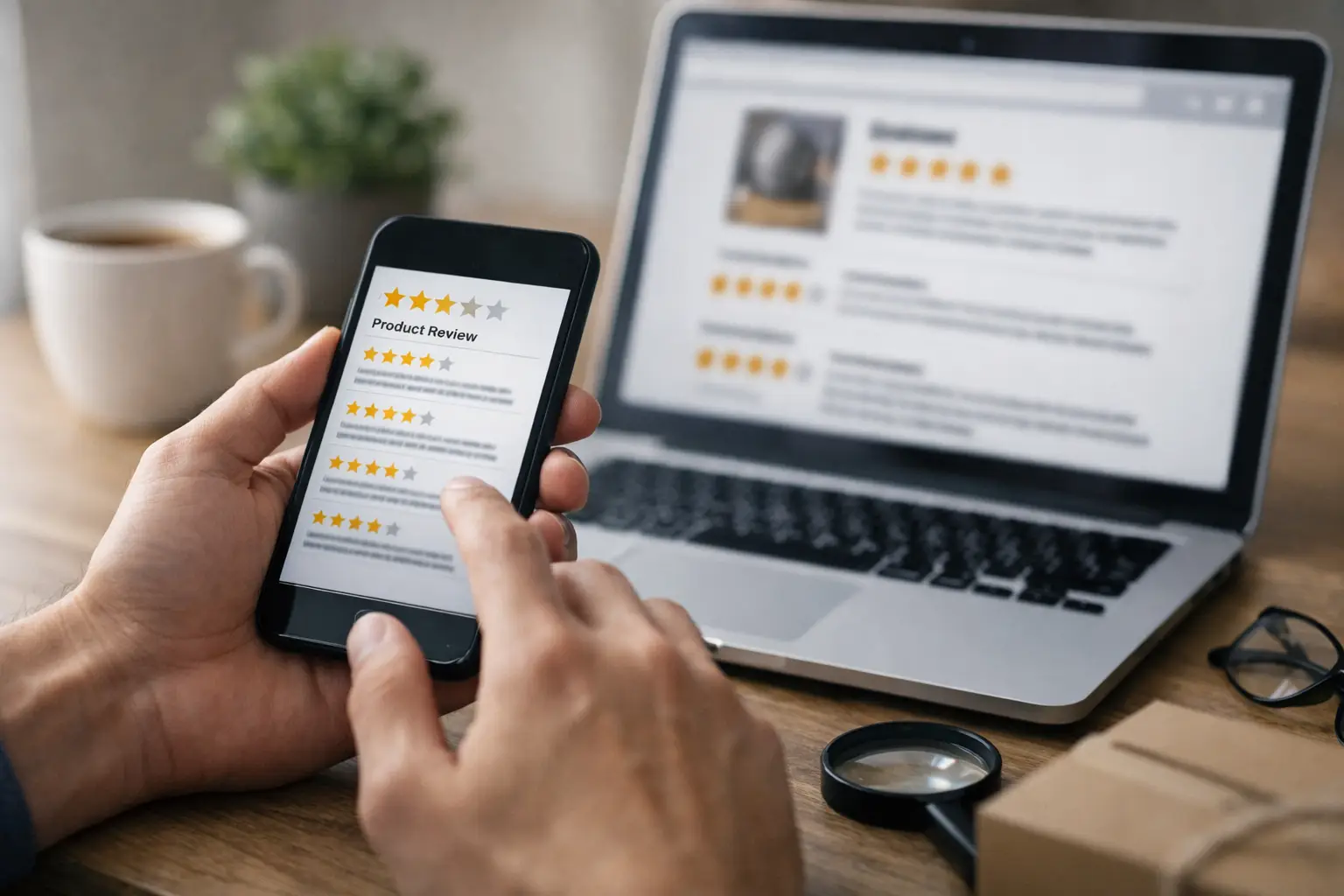
A five-star rating can look convincing until the kettle leaks, the hotel room faces a building site, or the scooter’s real range turns out to be nowhere near what the box suggested. So, can product reviews be trusted? Sometimes, yes. But a review is only as useful as the person behind it, the time they spent with the thing, and what they had to gain by saying it was brilliant.
For everyday buyers, the goal is not to find a perfect review. It is to find enough honest detail to make a sensible call with your own money. Real Vlogs. Real Places. Real Reviews. That mindset matters whether you are choosing a takeaway spot, booking a weekend away or comparing a bit of gear you will actually use every day.
Why reviews can feel unreliable
Reviews sit in an awkward place between personal experience and marketing. A buyer may genuinely love a product that would be useless for someone else. A creator may have been sent an item for free, while still giving a fair opinion. A brand may ask for feedback at the exact moment a customer is happiest, before any faults show up.
Then there is the obvious problem: some reviews are fake, bought or copied from vague templates. They tend to sound big on praise and light on proof. “Amazing quality” and “best purchase ever” tell you very little if the reviewer does not explain what they used it for, how long they had it, or what was not so good.
That does not mean every glowing review is dodgy or every critical one is trustworthy. Some people leave one-star ratings because a parcel arrived late, even though the product itself was fine. Others expect a budget item to perform like a premium model. Context is the difference between noise and useful information.
Can product reviews be trusted when money is involved?
A paid partnership, affiliate commission or gifted product does not automatically make a review dishonest. People who make videos and write about products need a way to fund the work. The better question is whether the arrangement is clear and whether the reviewer still gives you the awkward bits.
A useful sponsored review should tell you what was provided, what the creator was asked to do and whether they had any say over the final opinion. More importantly, it should still deal with the real-life downsides. Maybe the battery is decent but heavy. Maybe the restaurant food is great but the service is slow on a busy Saturday. Maybe a camera is easy to carry but struggles in poor light.
Watch out for content that feels like it came straight from a product page. If every sentence repeats brand claims, every feature is “perfect”, and there is no mention of who the product would not suit, you are watching an advert dressed as a review.
Being paid is not the only source of bias, either. Someone who spent a lot of money may defend their purchase because they do not want to feel they got it wrong. A loyal fan of a brand might give it more patience than a first-time buyer would. That is human nature, not necessarily bad faith. It just means you should compare more than one perspective.
Look for use, not just opinion
The most believable reviews usually contain small details that would be hard to invent. They show the muddy path after a rainy walk, the queue outside a food spot, the awkward storage issue in a small flat or the charger that became annoyingly warm after an hour.
A reviewer does not need to be a technical expert to be helpful. In fact, for many purchases, an ordinary person’s experience is exactly what you need. If you are looking at an electric scooter, you may care more about getting it up a kerb, carrying it through a hallway and riding it home in British weather than hearing a long list of specs.
That is why video can be especially useful. You can see the size of an item in someone’s hands, hear how loud it is and judge whether they look comfortable using it. But video is not proof on its own. Clever editing can hide a lot. Look for longer clips, follow-up updates and moments where the product is used naturally rather than displayed for the camera.
Four signs a review is worth your time
- It explains the situation. Good reviews say who the product is for, how it was used and what the reviewer expected from it.
- It includes specific positives and negatives. A real experience rarely has no compromises at all.
- It shows evidence. Photos, video, measurements, receipts, repeat visits or a note after several weeks all add weight.
- It sounds like a person. Natural wording, small frustrations and practical observations are more useful than polished sales language.
None of these signs is foolproof. A detailed review can still be sponsored, and a short review can still be completely genuine. Think of them as clues, not a lie detector.
Read the middle, not only the rating
The star average is a quick shortcut, but it can hide the part that matters. Read a mix of recent three-star, two-star and four-star reviews. These often contain the most balanced information because the reviewer found something worthwhile but also ran into a real limitation.
For a restaurant, one poor review about a long wait may not matter if you are going on a quiet weekday. Ten separate reviews mentioning cold food or surprise charges should make you pause. For a product, repeated comments about a weak hinge, missing parts or poor customer service deserve more attention than one angry post.
Dates matter as well. A review from three years ago may describe an older version, previous owners or a problem the business has already sorted. On the other hand, a sudden flood of five-star reviews posted within a few days can be a reason to look more closely.
It also helps to separate delivery and support problems from the item itself. A courier damaging a box does not prove the headphones are rubbish. But if the company refuses to help when the same fault appears across several reviews, that tells you something about the full buying experience.
Match the reviewer to your real life
The best reviewer is not always the biggest creator or the person with the fanciest setup. It is often someone whose needs look like yours. A commuter’s view of a scooter may be more useful than a stunt rider’s. A family’s take on a café may matter more than a food critic’s if you need space for a buggy and do not want to spend half an hour finding parking.
Ask yourself what you need the item or place to do. Are you after the cheapest option, something that lasts, a treat for one night, or gear that has to cope with regular use? Once you know that, you can spot which reviews are actually relevant.
This is where first-hand, experience-led content earns its place. At Vlog Life 247 Blog, the point is not to pretend every outing or product is flawless. It is to show what happened, what stood out and what a normal person might want to know before spending their cash or giving up their weekend.
A sensible way to make the final call
Before buying, check a handful of reviews across different places rather than trusting one score or one creator. Look for patterns, not perfection. If several people independently mention the same strength or problem, it is more likely to be part of the real experience.
For an expensive purchase, give yourself a bit of time. Search for long-term updates, common faults and comments from people who use the product in the same way you plan to. For a small purchase or a local lunch, you do not need a full investigation. Just make sure the praise has some substance behind it.
Trust is earned in the details: the minor annoyance a reviewer did not hide, the rainy-day footage, the update after a few months and the honest line that says, “This is good, but it will not suit everyone.” Read reviews with your eyes open, then let your own needs make the final decision.
Leave a Reply