
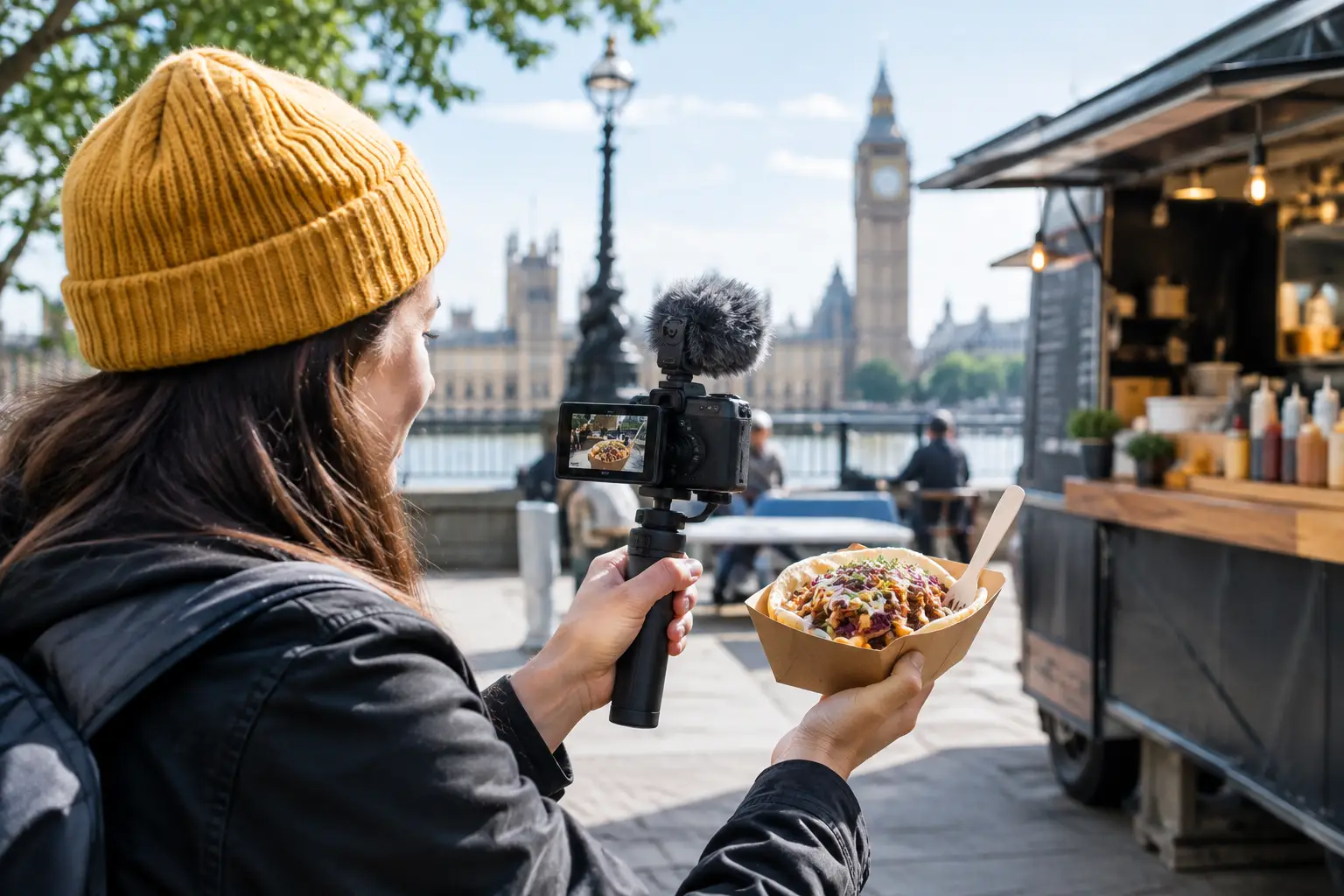
A busy food market can look brilliant on camera: steam lifting from a hot grill, sauces being poured, people deciding what to order. It can also go wrong quickly if the footage is shaky, the sound is buried under a generator, or the person serving is not comfortable being filmed. This beginner street food filming guide is about getting the useful shots while staying present, polite and out of everyone’s way.
Street food works best when it feels like a real place rather than a staged review. You do not need a cinema-sized camera setup or a long script. You need a simple plan, a little awareness of light and sound, and the confidence to ask before pointing a lens at somebody’s stall.
Plan the story before you order
The strongest food videos usually answer a few basic questions: where are you, what has brought you to this stall, what is being made, and what does it taste like? That is enough of a structure for a short vlog segment without turning lunch into a production.
Before filming, walk around once without the camera raised. Notice which stalls have an interesting cooking process, whether there is room to stand without blocking a queue, and where the light is falling. A stall that looks excellent from the front may have a bright sky directly behind it, leaving the food and vendor in shadow.
It also helps to decide what you genuinely want to eat before filming. Chasing a dramatic-looking dish that you do not fancy can make the reaction feel forced. A simple, honest meal is more useful to viewers planning a day out than an overdone verdict.
Beginner street food filming guide: ask first
A quick, friendly question makes a real difference. Try something straightforward: “Would you mind if I filmed a few clips while you make that? It’s for a food vlog.” Most traders are used to customers taking photos, but filming is more noticeable, particularly if you want to include their voice or face.
If they say no, thank them and move on. There is always another angle, another stall, or a way to film your own food after it has been served. Respecting that answer is part of filming in public properly.
When they are happy to be filmed, keep the camera work light. Avoid asking a trader to repeat steps during a rush, and do not hold up the queue to get one more shot of the garnish. The best footage often comes from observing what is already happening.
Be careful around other customers too. Wide shots of a market atmosphere are generally less intrusive than close-ups of strangers eating. If someone becomes a clear focus of a shot, especially a child, it is sensible to ask or change the angle.
Film the food being made, not every second
Food preparation has natural moments that tell the story. Capture the initial sizzle, the turning or stirring, a close shot of texture, the final garnish, and the handover. Those clips give an edit plenty to work with without requiring ten minutes of continuous footage.
Get a wide establishing shot first. This might show the stall sign, the market lane or the cooking station. Then move closer for detail: a ladle of curry, crisp edges on a frying pan, smoke from a barbecue, or a tray being loaded. Finally, take a clean shot of the finished food before you start eating it.
Close-ups need a steady hand. Hold the phone or camera with both hands, tuck your elbows in, and move slowly. A cheap grip, mini tripod or small gimbal can help, but none of them fixes rushed movement. If you are walking towards a stall, take a few careful steps rather than trying to sweep through a crowd at speed.
There is a trade-off with slow-motion footage. It can make pouring, chopping and sizzling clips look great, but it needs plenty of light and can make an otherwise natural vlog feel overly polished. Use it for one or two moments, not the whole visit.
Keep the lens clean
Street food means steam, grease and fingerprints. A smudge on the lens can soften every shot without being obvious on a small screen. Carry a clean microfibre cloth and give the lens a quick wipe before filming the finished dish. It takes seconds and is one of the easiest ways to improve phone footage.
Sound is often the harder part
Markets are noisy by nature. Music, crowds, traffic, generators and cooking sounds compete with every spoken sentence. A phone microphone can record the atmosphere well, but it may not catch a quiet introduction when you are standing beside a busy road.
For a simple setup, step a little away from the stall after ordering and record your introduction there. Speak clearly, turn away from the wind where possible, and keep the camera fairly close. If you use a small clip-on microphone, fit it before arriving at the market rather than trying to sort cables with food in your hands.
Do not remove all background noise in the edit. The clatter and chatter are part of the place. What matters is that viewers can hear the key information: the name of the dish, what is in it, and your thoughts after trying it.
If the trader explains something interesting, ask whether they are happy for you to record it. A short natural answer about the food can be more memorable than a long piece to camera. But if the noise is too heavy or they are busy, do not force it. Add the detail later in your own voice only if you are sure it is accurate.
Use light without chasing perfection
Overcast British weather can actually be helpful for food filming. Cloud cover softens harsh shadows and makes it easier to show the colour and texture of a dish. Bright midday sun is trickier, especially with shiny sauces or white takeaway boxes that can appear overly bright.
If you can, turn so the light falls across the food from the side rather than directly behind it. This gives texture to grilled meat, pastries and toppings. At a covered market or evening event, look for a brighter edge of the stall rather than relying on a dark corner under an awning.
Avoid using a bright camera light right in a trader’s face. It changes the feel of the interaction and can make a small stall look like a studio set. Natural light and a sensible angle are usually enough for a vlog.
Give viewers the details they need
Once the food is in hand, take a moment before the first bite. Show the portion, explain what you ordered, and mention any useful detail you can verify at the time, such as the dish name or a clearly displayed price. Do not guess ingredients, opening times or prices that you have not confirmed.
A reaction does not need to be big to be watchable. Describe something specific: the heat level, crunch, freshness, portion size or whether one element stood out. If something is messy, awkward to eat or not quite what you expected, say so fairly. Real Vlogs. Real Places. Real Reviews. That honest approach is more useful than pretending every mouthful is life-changing.
Try to include the surroundings as well as the plate. A quick shot of the seating area, market entrance or nearby event helps people picture the visit and makes the segment feel part of a wider day out. It also gives an edit breathing room between close-up food shots.
Edit for appetite, not length
When editing, start with the finished dish or the most visually satisfying cooking clip. Then build back to the arrival, ordering and preparation. This gives viewers a reason to stay without hiding the practical context.
Cut repeated clips, long waits and shaky pans. Keep enough natural sound to make the cooking feel lively, but lower it under spoken sections when necessary. Captions are worth considering, particularly for vendor conversations in noisy locations and for dish names that may be unfamiliar.
You do not need to score every food moment with music. A few seconds of frying, slicing or a paper bag rustling can feel more immediate than a soundtrack. It depends on the style of the wider vlog, but leaving room for the place itself usually makes street food footage more believable.
The next time you are out filming a market, aim for one good establishing shot, a handful of preparation details, a clear look at the finished food and an honest reaction. That small routine leaves room to enjoy the day while giving viewers a proper feel for the place.
Leave a Reply